Special alloys / Supply & sourcing
Controlled-expansion Nilo® alloys and high-molybdenum super-austenitic and nickel alloys for the most corrosive duties.
Grade discovery
Nilo® is a trademark of Special Metals; AL-6XN® is a trademark of ATI. Supply is confirmed against the complete specification.
Grades in this category
| Grade | UNS | W.Nr. | Key property | Typical use |
|---|---|---|---|---|
| Nilo® 42 | K94100 | — | Controlled low expansion (~42% Ni) | Glass-to-metal seals, lead frames, thermostats |
| Nilo® 48 | K94800 | — | Controlled expansion (~48% Ni) | Soft-glass seals, thermostat bimetals |
| Alloy 59 | N06059 | 2.4605 | Very high pitting resistance | FGD, chemical process, seawater |
| Alloy 926 | N08926 | 1.4529 | 6Mo super-austenitic | Seawater piping, FGD, offshore |
| AL-6XN® | N08367 | — | 6Mo + high N, seawater grade | Desalination, pharma, food processing |
The listed range is for supply and sourcing, not a statement of current stock. Grade, form, condition, make, origin, documentation and delivery are confirmed at quotation.
Source: Rajkamal Metals product range, October 2026. Source undated; reviewed 3 October 2026. Designations identify enquiries, not equivalence or suitability.
Forms we supply
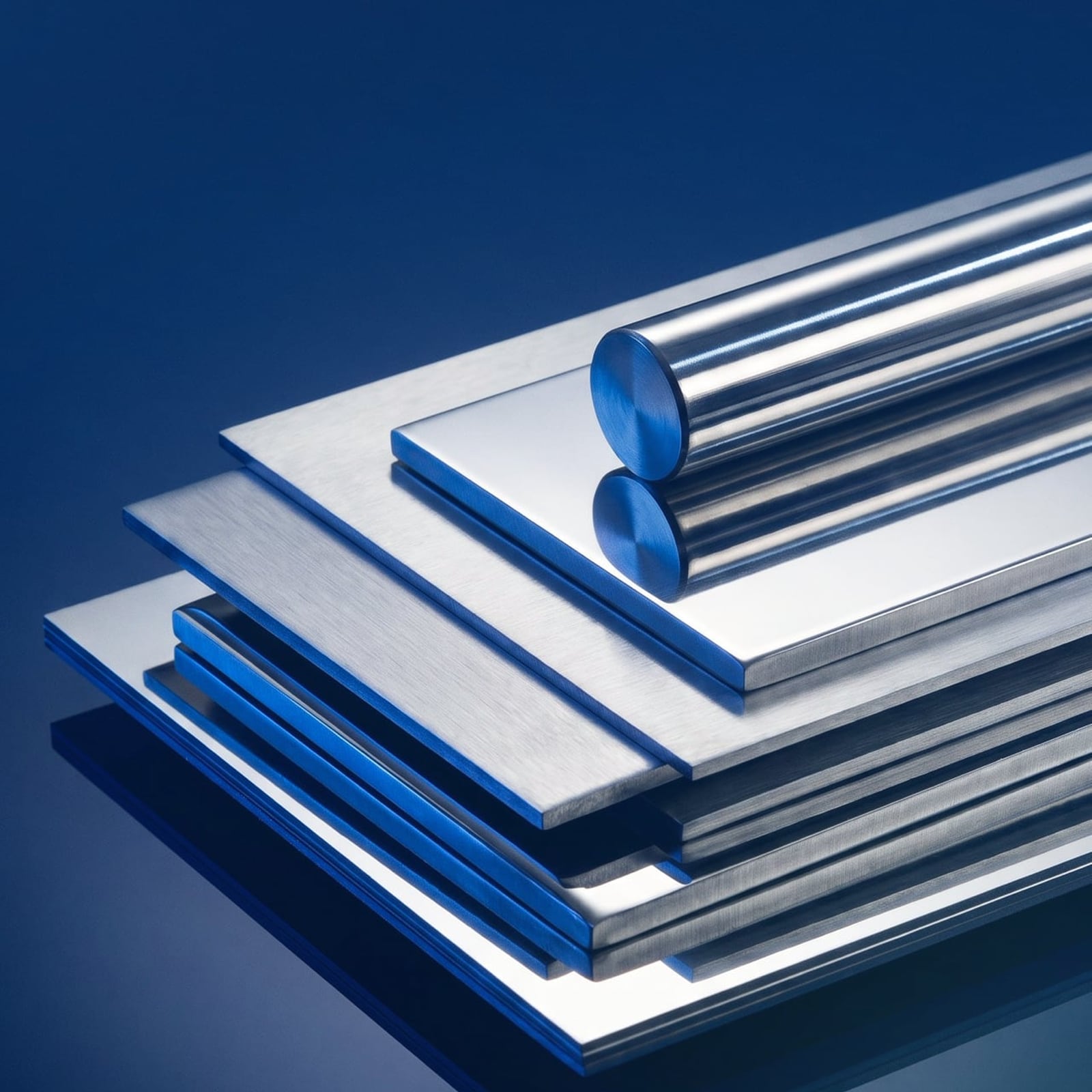
Special alloys in every common form.
Nilo® 42 and 48 iron-nickel alloys with low, controlled thermal expansion, and Alloy 59, Alloy 926 and AL-6XN® for seawater, acid and chloride service beyond the reach of standard stainless steels.
Corrosion & temperature resistance
Alloy 59, 926 and AL-6XN offer very high pitting and crevice resistance in chloride media; Nilo alloys are chosen for dimensional stability rather than corrosion resistance.
Applications
Glass-to-metal and ceramic-to-metal seals, lead frames and thermostat bimetals (Nilo); seawater cooling, desalination, FGD and chemical process equipment (59, 926, AL-6XN).
Before we quote
These fields help us review your request. Size range, make, origin, condition, documentation and availability are confirmed against the complete enquiry.